
 By
Guy Adams - CTO, DataOps.live
By
Guy Adams - CTO, DataOps.live

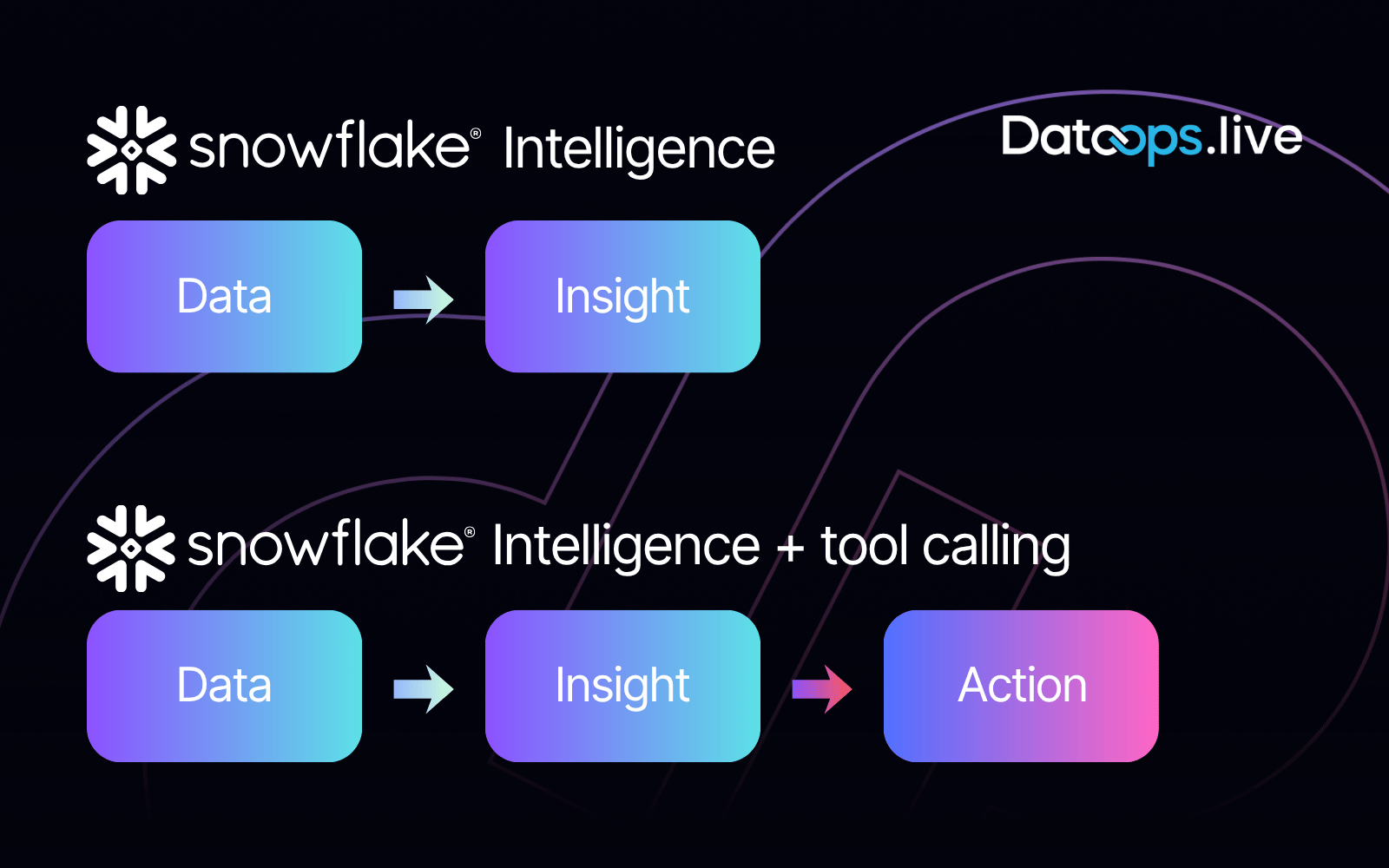
The natural language queries are incredible, but the superpower happens after you get your answer.
I’ve been watching the conversation around Snowflake Intelligence with growing frustration. Everyone’s talking about how to connect your data, how to set up semantic models, how people can ask questions in natural language. And sure, all of that matters. In fact it’s really cool. But it’s the “getting started” chapter.
The real story—the one I think could genuinely change how organisations operate—is about what happens after you get your answer. And almost nobody is talking about it.
Here’s the dirty secret about analytics
Let me be blunt about something the analytics industry has quietly accepted for decades: BI tools are brilliant at telling you what happened. On a good day, they’ll even tell you why. They’ll surface an insight, visualise a trend, flag an anomaly.
And then they stop.
That’s it. Here’s your dashboard. Here’s your chart. Good luck figuring out what to do about it.
I’ve seen this play out so many times it’s almost comical. A BI tool flags that a customer segment is unhappy. Someone screenshots the dashboard. They paste it into a Slack message. Three people discuss it. Someone creates a Jira ticket. A week later, maybe someone takes action. Maybe.
That gap between “I now know something” and “I’ve done something about it” is the silent killer of data-driven decision making. And every analytics tool in history has essentially shrugged at it.
Snowflake Intelligence gets you to the same point of insight, but much faster and more naturally than traditional tools. It can tell you a customer is unhappy, a metric is trending the wrong way, a process is broken. But here’s the thing: if you stop there, you’re using maybe 30% of what it can actually do.
The feature everyone’s sleeping on: tool calling
The capability that transforms Snowflake Intelligence from a smarter BI tool into something fundamentally different is tool calling. And I’m genuinely surprised how few people are talking about it.
Here’s what tool calling actually means in practice: when a Snowflake Intelligence agent surfaces an insight, it doesn’t have to stop at the answer. It can reach out to external systems like your CRM, your ticketing platform, or your operational tools to take action.
Think about that for a second. This isn’t a dashboard you stare at. This isn’t a report you forward to someone who forwards it to someone else. This is an intelligent agent that identifies a problem and starts solving it, all within the same conversation where you asked the question.
That’s a game-changer. And I don’t use that phrase lightly.
Let me make this concrete
Say you’re asking Snowflake Intelligence about customer satisfaction trends. It identifies a segment of customers who are consistently unhappy. It digs into the data and finds the root cause: these customers are on a service plan that doesn’t match their actual usage. They’re consuming more data than their plan allows, and the experience is suffering.
In the old world — and by “old world” I mean what most companies are doing today — that’s where the story ends. Someone finds the insight. They go email someone in customer success, who’ll raise it in their next team meeting, who’ll maybe create a task in the CRM, who’ll eventually reach out to those customers. In a few weeks. If you’re lucky.
With tool calling in Snowflake Intelligence, the agent can immediately kick off a flow in your CRM to upsell those customers to the right plan. Not next week. Not after three rounds of “just checking in on this.” Right now, in the same conversation where the insight was surfaced.
And that’s just one scenario. Think about what else opens up:
-
A data quality issue is detected — the agent opens a trouble ticket with the engineering team, complete with context, severity, and affected datasets. No screenshots. No copy-paste. Just a properly formed ticket, created in seconds.
-
A supply chain anomaly gets flagged — the agent cross-references it against your logistics platform to work out whether it’s a one-off or part of a broader pattern, then alerts the right people with a summary they can actually act on.
-
A high-value customer hasn’t engaged in 30 days — the agent triggers an automated re-engagement sequence in your marketing platform before anyone even notices the silence.
In each of these cases, the distance between knowing and doing collapses to almost nothing. If you’ve ever been in an organisation where insights die in dashboards, you can feel how big a deal this is.
Why this changes the definition of analytics
For years, we’ve all talked about being “data-driven.” But let’s be honest: most organisations are data-informed at best. They look at data, they discuss data, they make decisions that are loosely inspired by data. The actual action — the thing that moves the needle — still relies on human coordination, manual processes, and institutional momentum.
Tool calling in Snowflake Intelligence is the bridge between data-informed and genuinely data-driven. It’s the mechanism that lets an insight flow directly into an action without the friction, delay, and information loss that comes with human handoff chains.
And Snowflake Intelligence isn’t limited to kicking of operational workflows. It can also initiate the build of governed data products using DataOps.live. A data product is a reusable, production-ready dataset or analytical asset that’s tested, documented, governed, and ready to be used across the business.
Spot an interesting pattern? Tell Snowflake Intelligence to work with the AI DataOps agent in DataOps.live, Metis, to turn it into a governed data product.
We’re going to cover this in depth in an upcoming post. But the key point is this: the same conversational interface that surfaces your insights can also create lasting, reusable outputs that the business can trust. That’s super powerful.
So why aren’t more people using this?
Part of it is positioning. The demos and the conversation so far have mostly focused on the natural language query experience: asking questions, getting charts, exploring data conversationally. And that IS impressive. But it inadvertently frames Snowflake Intelligence as a better way to ask questions, when it’s really a better way to act on answers.
There’s also a mental model problem, and I think this one runs deep. Most people think of analytics tools as read-only. You look at data. You don’t do anything with it from inside the tool. That’s someone else’s job. Tool calling breaks that assumption entirely, and it takes a minute for people to recalibrate their expectations about what an analytics tool should do.
But here’s the catch: the organisations that get this, the ones that start thinking about Snowflake Intelligence as an action layer sitting on top of their data, are going to operate at a fundamentally different speed to their competitors.
The bottom line
Every other analytics tool gives you the “what” and the “why.” Snowflake Intelligence gives you the “what next.”
And that’s the piece almost nobody is talking about. Yet.
 Share
Share




.png?width=400&height=250&name=DOL%20Events%20and%20Webinars%20(3).png)